woensdag 11 maart 2009

Nuon Takeover by Vattenfall


I was a bit concerned by a picture taken at the press announcement of the Nuon takeover by Vattenfall:


It reminded me immediately of another landmark photo that ended up in less fortune:
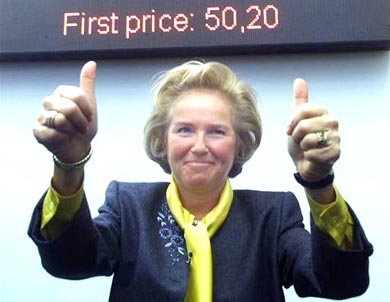

What is it with the "thumbs up"?

dinsdag 10 maart 2009

Give Me 4 Parameters and I Can Fit an Elephant...


Statistics have always been a popular subject for generating nice sayings. One of my favorites is:

"Give me 4 parameters and I can define an elephant, and with 5 I can make him wiggle his trunk." (by John von Neumann)

People with a solid background in modeling understand; the more parameters you use to model reality, the better it will describe -or I should say "fit"- past observations, but the less it will predict the future.

What a surprise I had when came across a case of a Brazilian Bank which implemented a customer segmentation model based on 6.000 behavioral characteristics.

Anyone, and I mean anyone, with even a basic understanding of statistical modeling knows this is nonsens. Yet greater was my surprise when I found myself debating with a colleague whether this was useful in case of perfect data.

No, No, No.

Perfect data suggests zero noise, which means the model is deterministic. The idea that behavior is deterministic is of course nonsense. This would imply we would be perfect robots and these 6.000 parameters would predict all our behaviors.

Fact is that serious modelers know that it's all about modeling statistically with as few parameters as possible. Proper statistical models are built so that they predict the future as good as possible, rather than the past. One must realize that most models are completely inept of forecasting at all, but are useful for understanding the mechanics of a process.

Are bad forecasting models an exception? Unfortunately not. And I confess: I too have manipulated statistics in the past in order to achieve a business object. This brings be to another favorite saying in statistics:

"Figures don't lie, but liars do figure".

For serious statistics buffs I recommend Priestley.

Can a Utility Company Walk Your Dog?


Last year I was at our
High Performance Marketing Congress were a manager of a utility company suggested that they were developing new services to reduce customer attrition. So far, nothing extraordinary. But then he suggested that they were considering to offer to walk your dog. Now this was odd!

While wondering if this was a joke on the audience, I found out it was for real. This raised my thought: can a utility company walk your dog?

For months I strolled along with this question. Why is this so odd? What is not right?

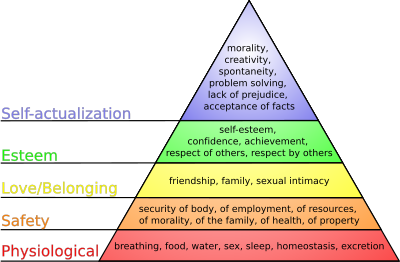
Recently I spoke to a colleague and we discussed the Maslow hierarchy of needs. Then it jumped into my mind. Utility Companies, as the name suggests, offer commodity services. Power, water, sewage, etc. Stuff you really must have and rely on that it's there, but never think or care about. In essence, they fulfill my physiological needs.

Although I don't own a dog, I can imagine that most people consider them as part of their (extended) family. Some would have one to enhance their achievement, like Paris Hilton's Tinkerbell. This implies that their dog is either on the level of Love/Belonging or on the level of Esteem. Both are significantly higher in the hierarchy than a utility company.

So, would you trust your dog, which is part of your family or represents your achievement,
to your utility company, which does not give you any emotion? Of course not, you care about your dog!


So what does this tell us?

I believe that a company can choose to either extend its brand by developing new services on the same Maslow level it
currently has, or to build its brand by gradually going up in the hierarchy, but only one step at a time.

An example of the latter is Page toilet paper. Toilet paper used to be a commodity but Page cleverly lifted its status to that of Family/Belonging. It's soft, "pillow soft, extra think and a little bit of extra luxury". In fact you would even entrust it to your dog.

Wow!


The Power of the Feel Good Factor


Three years back I got my first
Apple gadget, an Apple iPod nano. In fact, all my colleagues got one too. Our boss said that this would surely be the first of many to follow. Next day we all took it proudly to work at our clients and got a lot of response. It made us feel proud and valued.

Then, about a year ago, my wife got an iPod Touch of her boss. Clearly this was the king-of-the-hill of gadgets. I confiscated it as it made no sense for her to have it. It made me jealous.

Why? Because having it made me feel good.

The apple counter now jumped to 2.


Half a year ago I bought an iMac for the kids... Well, let's say that daddy likes playing with kids toys. I thought it was time for them to start using a computer and I wanted to have some parental control, meaning it should be in the living room. No other computer has made it to my living room so far. Too ugly. But the iMac is a gem worth showing off to your friends and family. The iMac quickly became the device of choice for photos and as a DVD player for the kids.

The counter was 3.


Just before Christmas I got some reward points for good work. My employer could have given me the money instead, but these points allowed me to shop at a gadget portal. So I bought a new iPod Chroma (in limited edition red) and an Airport Express. I just love the iPod Chroma and notice that I take it along with me, even if I don’t use it.

Why? It make me feel good.

The counter was 5.

At Christmas I figured that the iMac experience was so different from what I what used to, that I wondered why I was accepting feeling bad each da

y that I got my work laptop out of the bag. I listed all my frustrations. ugly, slow, no control, no differentiation.

I decided to buy my own laptop and use it for work. And that's what I did, I bought an MacBook Pro (new monobody). I could have bought a laptop probably for half the money, but than, what would have been the difference with the one I had? The macBook is a gem, wow.

Why? because it makes me feel good and it states to my colleagues that I take care of myself.

The counter is 6. Well, I also bought a Time Capsule (7) and some other peripherals I will not mention...

So, what happened?

Apple clearly was way higher in the Maslow pyramid than other technology providers. I allowed Apple to be part of my family. And by doing so I became part of the Apple community. And it feels good. Those are characteristics of the layer of Esteem. Only few brands make it to that level and those are genuinely great.

Radio is Dead, Long Live Radio!


Some time back I bought a Bose music box for my iPod
Touch. Not that I needed it, but it looked great and the buy made me feel good.

I set it up in the kitchen and I could listen to the music on my iPod. My problem was that I have a need.

I have a need to listen to news. In the past I would have bought a radio, had to pay listening taxes (a remnant of Jurassic thought) and had only limited choice of radio channels. Even though the taxes are now payed through generic taxes payments, the fact remains that public radio is financed through taxes. And beware of the pirate stations, they steal bandwidth!

These days I have an Internet enabled generic device, like an iPod, I go to a site like shoutcast or download the shoutcast app on my iPod Touch. Instantly I have access to thousands of radio stations for free.

Schoutcast posts nice stats. They list that the last 30 days, lets say approx Feb 2009, total
TTLS was 340 million. Now TTLS stands for Total Time Spent Listening and is measured in hours. This equals to nearly 1 million people listening for 1 hour every day of the year. But then this time was only spent on the last 30 days...

Before I forget to mention, the monthly growth rate is approx 7%.

Interestingly, the "official" radio stations (like national Radio 1) are not (yet?) online. So basically I pay taxes to keep up the museum called Hilversum or "Publieke Bestel".

Just for you to know.

donderdag 27 maart 2008

Why Operators are not opening their networks

Apparently cable operators are reluctant to open their networks, because this would strengthen the position of the incumbent telco's. This is an artifact of a somewhat shortsighted vision.

The response was to be expected and is caused by the view of operators on their competitive market. A known problem with Porter's 5-forces model is that of defining the relevant market. Cable operators traditionally regard their market as distributors of broad casted content. Therefore new competitors using DVB-T, such as KPN, are seen as new entrants and internal competition would come from other cable operators. This is a flawed definition of the market.

First of all, cable operators are hardly each others competitors, because the coverage of their network is non-overlapping. This means that cable operators compete with operators using different network technologies, such as fiber, DSL or DvB-T. In the Netherlands this implies that KPN is their main competitor.

Secondly, a significant share of the ARPU is not generated by analogue tv, but by other services and often in triple-play bundles. Since voice and broadband represent significant revenues, cable operators compete directly with incumbent telco's that use DSL in stead of Eurodocsis. Therefor, again, KPN should be considered an internal competitor in stead of a new entrant.

So what are new entrants?

In my opinion Over-The-Top operators are new entrants. Such operators do not own a network, but piggyback on operators networks to deliver services. This reduces integrated service providers to "bitpipe" providers wih a percieved low added value. Examples of such providers are Skype, Google, Microsoft, Yahoo, YouTube, Apple, Vuze (bittorrent), Joost.com, etc.

If cable operators -and incumbent telco's- would have defined their internal market larger, they could have a different perception of internal competition and competitive pressure of new entrants. This would have made them understand that there are other, new market forces at play and they cannot control it.

Only bold operators neutralize these new entrants by embracing them in there networks. Such bold operators would seamlessly integrate the OTT services in their offerings, likewise Apple has integrated YouTube on its Apple iPod Touch.

Further Analysis of the Telecom Market

My analysis of the current telecom market found some resonance. People recognize that web 2.0 is a catalyst for market transformation. Yet, web 2.0 seems a difficult terminology to grasp. The terminology was first introduced by Tim O'Reilly as a business revolution in the IT industry caused by the move to Internet as a platform. It seems at best that web 2.0 can only be characterized in non-exhaustive terminologies, which, at least partially, explains its inflation.


Some characteristics can be (according to Best and others):

    • rich user experience
    • user participation
    • dynamic content
    • meta data
    • web standards
    • scalability
    • openness
    • freedom
    • collective intelligence by way of user participation


A terminology that struck here particularly in this context was "crowd sourcing", we will come back to this issue later.


Back to my initial assessment.

A first remark on the observation that the market is stagnant in the Netherlands (I've not assessed this for more markets but I have reason to believe this is generic for all developed countries). To understand the reasons for stagnation, you need to understand the three key drivers behind the phenomenal growth in the '90's and early 00's.

  1. Privatization and deregulation: In the '80's the US privatized and split-up AT&T followed by an active deregulation policy of the FCC. This trend was adopted in the '90's by most EU members. KPN was privatized in 1989, and had its IPO in 1994. Until 2006 the State had a golden share in KPN.

  2. The rise of GSM: GSM was formed in 1982 and the GSM specifications were set by 1987. ETSI adopted the standard and ratified it in 1990. Its first commercial deployment started in 1991 in Finland ans soon spread over the globe. In 1993 the first GSM network in the Netherlands replaced the analog ATF-1~3 networks. In 15 years time mobile penetration rose from near 0% to 130% in the Netherlands. Historically, this is nothing less than a revolution!

  3. The rise of the Internet and broadband: The history of the internet is well documented and in the Netherlands specifically it was commercially launched in 1989 by NLNet (only B2B) and XS4ALL (1993, now owned by KPN) via dial-in. Soon this created the demand for broadband. I recall being in a technical summer school as a student at KPN research in 1995 and we were "enlightened" by promising technologies such as ADSL, ATM and fiber. Not a lot of people realized this but just a few years later, KPN followed BBNed (Telecom Italia!) as market leader in DSL in the Netherlands and most of their networks were ATM over DSL. Cableco's followed with Eurodocsis and the rest is known. Currently the broadband penetration is over 33 lines per 100 inhabitants, which is about 70% of households in NL. Yet if you look at the traffic of the Amsterdam internet exchange, the largest Internet exchange in the world, you see two things:

  1. the avg bandwidth is low (typically less than 64kbps per connection or 1 E0)

  2. the bandwidth is rising dramatically since the emergence of Youtube:

Untitled Attachment


The crossroad of these three drivers, each by itself a revolution, caused a phenomenal growth of the industry into maturity in about 10 years time. It seems that whereas the 90's were the decade of the rise of the networks, the 00's are the decade of the transformation of societies caused by the paradigm changes of the 90's (Internet as a platform or web 2.0!)


Next the categorization of the traditional, vertically integrated service providers:

Not knowing of the existence of the article "Unbundling the Corporation (Harvard Business Review; Mar/Apr99, Vol. 77 Issue 2, p133-141), we split a typical Telco up in three layers. It's a reassuring though that we derived these three layers independently from the authors of this publication (both were principles of McKinsey at the time). The article gives more substance behind the thought. If you read the article you will see it matches completely. They analyze:

  1. CRM:
    • Economics: high customer acquisition makes it imperative to gain large wallet shares; economies of scope are key
    • Culture: Highly service oriented; "customer comes first"
    • Competition: Battle for scope, rapid consolidation, few big players will dominate

  1. Product Innovation:
    • Economics: early market entry allows for premium price and lager market share. Speed is key
    • Culture: Employee centric; coddling the creative "stars"
    • Competition: Battle for talent; low barriers for entry; many small players thrive
  1. Infrastructure Management:
    • Economics: High fixed costs make large volumes essential to achieving low unit costs; economies of scale are key
    • Culture: Cost focused; stress on standardization, predictability and efficiency
    • Competition: Battle for scale, rapid consolidation, few big players will dominate


As you see this resembles my observation nearly perfect. As a result of this I conclude that:

  • the high fixed costs are high barriers for entry in the infrastructure space. Yet, they also restrict innovation, for instance the roll-out of FttH. Hans and I discussed that the ambition level of KPN to install 5k FttH lines per month is hardly noticeable. At this rate only 600k households will have FttH in 10 years time, or less than 10% of all Dutch households. A national roll-out (7M households) would cost about EUR 7B, a number the market could bare. Compare this investment to high-visibility investments in the high-speed railway (EUR 6.3B and counting) and the railway track "Betuwelijn" (EUR 4.7B and counting). Imagine what a catalyst to the economy it would have been if this money was invested in FttH in NL. A collegue and I discussed the role of the regulator in this area. I believe this role is imperative, as without it, the market will not have sufficient incentives to invest in infra's with a 30 years business case. Especially because the highest risk for such long depreciation cycles is the regulatory authority and the State itself. Not coincidentally the countries with the fastest growing FttH deployments are countries with a strong state influence (Korea, Dubai, etc.).
  • the high costs of customer acquisition (I was involved in a pilot which resulted in a CAC of over EUR 400 for a consumer customer of EUR 240 ARPU and less than 15% operational margin) will drive any company with a significant customer base to diversify its product/service portfolio. Banks are entering the Telco space (as they have done in the '90's), but strangely enough, Telco’s do not demonstrate such bold moves into new markets. Maybe their CRM capabilities are lagging too much to pursue such a strategic shift.
  • The battle for talent is withholding the operators from succeeding in the product innovation space. Google and the likes are much more successful. Sergey Brin (CTO and founder of Google) announced a contest for the most innovative application for their new mobile platform Android. The winner gets $10M. How many submits do you think they will get? Typically just one new service development would cost a traditional telco such an investment. This demonstrated the power of "crowd sourcing". Other examples are the X-price (for commercial space exploration) and others.


Ultimately, I believe there is a burning platform. The current business models and positions are not sustainable. There are very successful companies that have demonstrated several strategic shifts in the past. Take Nokia. Once it was in the timber/paper industry, then in rubber boots via TVs into mobiles. So it transformed from an agricultural monopoly into an industrial company into a high-tech company. It takes bold leaders to make such shifts. A more local example is Akzo, which sold its bulk-chemicals and medical divisions and is focusing on paints.


I believe it is worthwhile to analyze this further, including quantitative data, references to Harvard Business Review, statistical data, apply Porter’s 5-forces model and so on.