woensdag 11 maart 2009

Nuon Takeover by Vattenfall


I was a bit concerned by a picture taken at the press announcement of the Nuon takeover by Vattenfall:


It reminded me immediately of another landmark photo that ended up in less fortune:
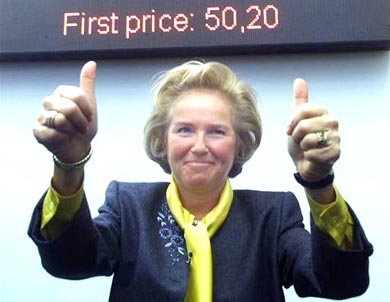

What is it with the "thumbs up"?

dinsdag 10 maart 2009

Give Me 4 Parameters and I Can Fit an Elephant...


Statistics have always been a popular subject for generating nice sayings. One of my favorites is:

"Give me 4 parameters and I can define an elephant, and with 5 I can make him wiggle his trunk." (by John von Neumann)

People with a solid background in modeling understand; the more parameters you use to model reality, the better it will describe -or I should say "fit"- past observations, but the less it will predict the future.

What a surprise I had when came across a case of a Brazilian Bank which implemented a customer segmentation model based on 6.000 behavioral characteristics.

Anyone, and I mean anyone, with even a basic understanding of statistical modeling knows this is nonsens. Yet greater was my surprise when I found myself debating with a colleague whether this was useful in case of perfect data.

No, No, No.

Perfect data suggests zero noise, which means the model is deterministic. The idea that behavior is deterministic is of course nonsense. This would imply we would be perfect robots and these 6.000 parameters would predict all our behaviors.

Fact is that serious modelers know that it's all about modeling statistically with as few parameters as possible. Proper statistical models are built so that they predict the future as good as possible, rather than the past. One must realize that most models are completely inept of forecasting at all, but are useful for understanding the mechanics of a process.

Are bad forecasting models an exception? Unfortunately not. And I confess: I too have manipulated statistics in the past in order to achieve a business object. This brings be to another favorite saying in statistics:

"Figures don't lie, but liars do figure".

For serious statistics buffs I recommend Priestley.

Can a Utility Company Walk Your Dog?


Last year I was at our
High Performance Marketing Congress were a manager of a utility company suggested that they were developing new services to reduce customer attrition. So far, nothing extraordinary. But then he suggested that they were considering to offer to walk your dog. Now this was odd!

While wondering if this was a joke on the audience, I found out it was for real. This raised my thought: can a utility company walk your dog?

For months I strolled along with this question. Why is this so odd? What is not right?

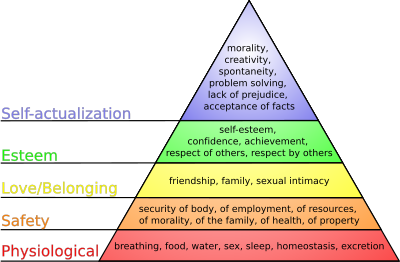
Recently I spoke to a colleague and we discussed the Maslow hierarchy of needs. Then it jumped into my mind. Utility Companies, as the name suggests, offer commodity services. Power, water, sewage, etc. Stuff you really must have and rely on that it's there, but never think or care about. In essence, they fulfill my physiological needs.

Although I don't own a dog, I can imagine that most people consider them as part of their (extended) family. Some would have one to enhance their achievement, like Paris Hilton's Tinkerbell. This implies that their dog is either on the level of Love/Belonging or on the level of Esteem. Both are significantly higher in the hierarchy than a utility company.

So, would you trust your dog, which is part of your family or represents your achievement,
to your utility company, which does not give you any emotion? Of course not, you care about your dog!


So what does this tell us?

I believe that a company can choose to either extend its brand by developing new services on the same Maslow level it
currently has, or to build its brand by gradually going up in the hierarchy, but only one step at a time.

An example of the latter is Page toilet paper. Toilet paper used to be a commodity but Page cleverly lifted its status to that of Family/Belonging. It's soft, "pillow soft, extra think and a little bit of extra luxury". In fact you would even entrust it to your dog.

Wow!


The Power of the Feel Good Factor


Three years back I got my first
Apple gadget, an Apple iPod nano. In fact, all my colleagues got one too. Our boss said that this would surely be the first of many to follow. Next day we all took it proudly to work at our clients and got a lot of response. It made us feel proud and valued.

Then, about a year ago, my wife got an iPod Touch of her boss. Clearly this was the king-of-the-hill of gadgets. I confiscated it as it made no sense for her to have it. It made me jealous.

Why? Because having it made me feel good.

The apple counter now jumped to 2.


Half a year ago I bought an iMac for the kids... Well, let's say that daddy likes playing with kids toys. I thought it was time for them to start using a computer and I wanted to have some parental control, meaning it should be in the living room. No other computer has made it to my living room so far. Too ugly. But the iMac is a gem worth showing off to your friends and family. The iMac quickly became the device of choice for photos and as a DVD player for the kids.

The counter was 3.


Just before Christmas I got some reward points for good work. My employer could have given me the money instead, but these points allowed me to shop at a gadget portal. So I bought a new iPod Chroma (in limited edition red) and an Airport Express. I just love the iPod Chroma and notice that I take it along with me, even if I don’t use it.

Why? It make me feel good.

The counter was 5.

At Christmas I figured that the iMac experience was so different from what I what used to, that I wondered why I was accepting feeling bad each da

y that I got my work laptop out of the bag. I listed all my frustrations. ugly, slow, no control, no differentiation.

I decided to buy my own laptop and use it for work. And that's what I did, I bought an MacBook Pro (new monobody). I could have bought a laptop probably for half the money, but than, what would have been the difference with the one I had? The macBook is a gem, wow.

Why? because it makes me feel good and it states to my colleagues that I take care of myself.

The counter is 6. Well, I also bought a Time Capsule (7) and some other peripherals I will not mention...

So, what happened?

Apple clearly was way higher in the Maslow pyramid than other technology providers. I allowed Apple to be part of my family. And by doing so I became part of the Apple community. And it feels good. Those are characteristics of the layer of Esteem. Only few brands make it to that level and those are genuinely great.

Radio is Dead, Long Live Radio!


Some time back I bought a Bose music box for my iPod
Touch. Not that I needed it, but it looked great and the buy made me feel good.

I set it up in the kitchen and I could listen to the music on my iPod. My problem was that I have a need.

I have a need to listen to news. In the past I would have bought a radio, had to pay listening taxes (a remnant of Jurassic thought) and had only limited choice of radio channels. Even though the taxes are now payed through generic taxes payments, the fact remains that public radio is financed through taxes. And beware of the pirate stations, they steal bandwidth!

These days I have an Internet enabled generic device, like an iPod, I go to a site like shoutcast or download the shoutcast app on my iPod Touch. Instantly I have access to thousands of radio stations for free.

Schoutcast posts nice stats. They list that the last 30 days, lets say approx Feb 2009, total
TTLS was 340 million. Now TTLS stands for Total Time Spent Listening and is measured in hours. This equals to nearly 1 million people listening for 1 hour every day of the year. But then this time was only spent on the last 30 days...

Before I forget to mention, the monthly growth rate is approx 7%.

Interestingly, the "official" radio stations (like national Radio 1) are not (yet?) online. So basically I pay taxes to keep up the museum called Hilversum or "Publieke Bestel".

Just for you to know.